- Home
- Great Malaysian Railway Journeys
Great Malaysian Railway Journeys
MALAYSIAN RAILWAYS
THEN & NOW

Welcome to my Great Malaysian Railway Journeys mini-website. I wrote these Great Malaysian Railway Journey pages during the period 2014-2017. They used to be hosted on a separate Weebly website but, since mid 2026, Weebly is no longer available for customers in Malaysia so I am transferring the content here. Some of the information may be outdated and of historical interest only.
INTRODUCING MYSELF
I'm David and I'm pleased to be your host and guide to this nostalgic tour of Malaysian Railways.
As a kid I was mad about trains and like most boys of my generation, I wanted to be a train driver. My Granddad worked in a factory building railway carriages and he lived in a small cottage backing onto the main London-Birmingham line.
I am just old enough to remember when steam locomotives used to thunder along that line. Whenever a train was approaching I used to dash to the pedestrian bridge above the tracks so that I could fill my nostrils with train smoke which was, weirdly, my favourite fragrance at the time.
I never made it to be a train driver but have always retained an interest in train travel and enjoy watching Michael Palin and others embark on railway journeys in exotic parts of the world.
More recently I was inspired by Michael Portillo's Great British Railway Journeys and when I came across a copy of a 100 year old travellers' guide to Federated Malay States Railways I thought it would be fun to do something similar about Malaysia which is where I now live.
In these Malaysian Railways journeys I travel by slow train from Penang to Singapore. With a copy of the Federated Malay States Railway's Pamphlet of Information for Travellers from 1914 as my guide, I retrace the sights and experiences of a hundred years ago and compare them with Malaysia today (and Singapore).

Stopping off at all the important towns along the way, I have taken photos of the places of interest listed in the 1914 guidebook where they still exist.
I'll be replicating some of the excursion itineraries mentioned in the guide and finding traces of defunct branch lines which have faded from existence.
We'll also see how the railway network of 'British Malaya' played an important role in the country's economic development and helped forge the modern nation of Malaysia.
These are the towns that we pass through in the order of the train journey from north (Penang) to south (Singapore) (click on the green headings or links to see the respective pages):
PENANG


This map is taken from the 1914 Pamphlet of Information for Travellers. Note that Penang Island, Province Wellesley and the Dingdings are coloured pink, the colour traditionally used on maps to denote British colonies. These territories, along with Singapore and Malacca made up the colony of Straits Settlements.
In this leg of my rail journey I will walk from the former FMS Railways building in George Town, Penang to the ferry terminal and catch the ferry across the North Channel to Butterworth, the closest station to George Town.
BUTTERWORTH
When the 1914 guidebook was written, Butterworth was little more than a ferry jetty and railway station. Today it is part of a large industrial zone. Penang Bird Park is located nearby.
BUKIT MERTAJAM

I hope to see the old Bukit Mertajam railway station before it is demolished to make way for line upgrading. Also worth seeing in this town is a colourful market and the famous St. Anne's Church, which I wrote about on my Thrifty Traveller blog.
Nearby towns mentioned in the 1914 guidebook are :
NIBONG TEBAL
People visit this small riverside town to sample their renowned crab porridge or curried prawns or to take an evening boat ride to witness fireflies putting on their nightly show.
PARIT BUNTAR & 5. BAGAN SERAI
The 1914 guidebook describes the countryside around these towns as a picturesque rice growing region offering good snipe hunting during the season (September to March). I'll not be doing any hunting but plan to stop off to see what these sleepy towns have to offer.
TAIPING

In 1914, Taiping was the headquarters of the British Administration of the State of Perak. The guidebook called Taiping the 'most beautiful town in the Peninsula'. It's still a pretty town.
From here we do a side trip to PORT WELD. The first railway line to be built in Malaya ran from Taiping to Port Weld (now Kuala Sepetang). Not much of that line remains now.
Read about the interesting community of Kuala Sepetang on my Thrifty Traveller blog.
KUALA KANGSAR

The scenery from the railway between Taiping and Kuala Kangsar is very fine according to the 1914 guidebook which also called Kuala Kangsar a 'remarkably beautiful' village.
The guidebook also refers to the Malay Residential College, a school for 'Malays of gentle birth'. The college is still running today.
SUNGAI SIPUT

Next stop is Sungai Siput, known for the lion-shaped hill which overlooks this small town. It is also infamous for being the place where the Malay Emergency started in June 1948 when three European planters where murdered on their respective estates by communist terrorists.
IPOH

The next section of our journey is from Batu Gajah down to Kuala Lumpur.
 Note that the modern day stations of Rawang, Sungai Buloh and Kepong did not exist when this old 1914 rail map was made. The branch line from Tapah Road to Teluk Anson Wharf (now Teluk Intan) was closed down in 1991.
There are a few remnants of the old Teluk Intan railway still surviving. Read about them here.
BATU GAJAH

There are a lot of interesting and well preserved colonial era buildings to see in Batu Gajah, which was once the hub of the Kinta Valley region. See my Batu Gajah Heritage Trail to learn more. One of Malaysia's last surviving tin dredges is located nearby. Read details here.
KAMPAR

Kampar is another typical Perak former tin mining town that has seen better days. The closure of the tin mines and the opening of the North-South expressway (which diverted traffic away from the town) sent Kampar into decline.You can see some photos of Kampar on my Thrifty Traveller blog.
TAPAH ROAD

Tapah Road has the second oldest railway station in Malaysia, which still survives (just) alongside the new one. Full details and photos here.
SUNGKAI

The new railway station is a little out of town. The main attraction in this area is the Sungai Klah Hot Springs Park. Read details here.
SLIM RIVER

Slim River has a few attractive temples close to the railway station.
For details and photos click here.
BEHRANG

This tiny town comprises a couple of streets of wooden shophouses. It is a quaint and sleepy little place and hardly justifies a station of its own. Find out more here.
TANJUNG MALIM

An historic mosque, an old rest house and police station and a famous pau shop are among this picturesque town's attractions. Read more here.
KUALA KUBU BARU

Kuala Kubu Baru sits on the road to Bukit Fraser and has a couple of waterfalls and trekking routes nearby. Click here for details.
RASA

Rasa seems a quiet and peaceful place with a few old buildings and lots of mature trees. Read more here.
BATANG KALI

An infamous incident took place here during the Emergency. Batang Kali has nice scenery and waterfalls nearby. Read details here.
SERENDAH

Serendah saw action during WWII. Serendah Waterfall and the Seven Wells (Perigi Tujuh) are among the local attractions. Click here for more.
RAWANG

Not a very exciting town but nice attractions nearby. You can read about them here.
SUNGAI BULOH

Site of an old leprosy settlement. Click here for more details.
KEPONG SENTRAL
This is the last stop before Kuala Lumpur. The FRIM Canopy Walk is a nearby attraction. You can find details here.
KUALA LUMPUR

Leaving Kuala Lumpur, the next stage of our Great Malaysian Railway Journey continues southwards through Kajang, Seremban, Rembau before arriving at Tambin.
The 1914 Pamphlet of Information for Railway Travellers only makes a brief mention of this stage of the journey from Kajang to Tampin:
"What some account the best dinner in the Malay Peninsula is served on the train after leaving Kuala Lumpur. It is advisable to defer going to bed until Seremban is reached at half-past ten, as passengers enter and alight there but after Seremban the very comfortable beds invite us.
As the speed over this section is not more than twenty miles an hour it is not difficult to sleep, and, the temperature falling at night, it is cool."
KAJANG
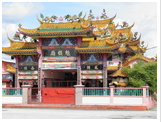
Kajang is a sprawling town on the southern fringes of Greater Kuala Lumpur. Among other things it is famous for satay.You can read more on my Thrifty Traveller blog.
SEREMBAN
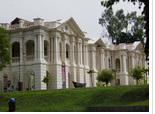
Seremban is the capital of Negeri Sembilan state. The town has some grand old colonial buildings, scenic Lake Gardens and an old railway station. See my Top Seremban Attractions page for more details.
PORT DICKSON
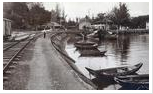
The Seremban-Port Dickson line closed down for freight in 2009 while passenger services ceased in the 1970's. Read more here.
Nowadays, Port Dickson is one of Malaysia's most popular beach resorts. Read details of the town's attractions here.
REMBAU
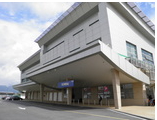
The ETS line was recently extended to Rembau providing fast trains as far as Rawang. The old Rembau station is no more, replaced by this new station. Read more here.
TAMPIN
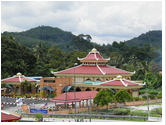
Tampin station is still operational but the branch line to Malacca is no longer in existence. You can see some of the sights of Tampin here.
MALACCA

Old Malacca station, St.Paul's Church, Jonker Street, Heeren Street, Stadthaus, Christ Church, Pulau Upeh, St. John's Hill, Bukit China, Church of St. Peter, Tanjong Kling and more.
BATANG MELAKA
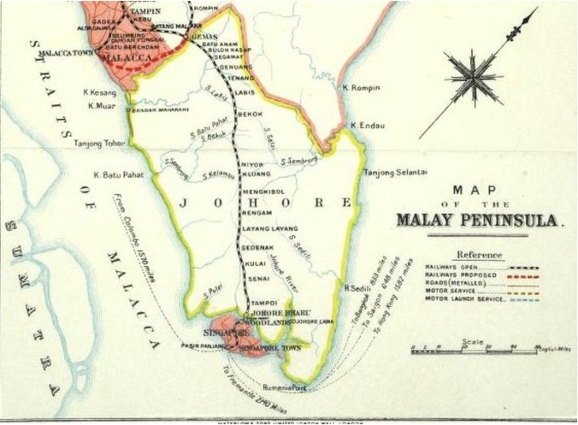 1914 Railway Map Showing Sector from Batang Malacca to Johor Bahru.
The 1914 Pamphlet of Information for Travellers published by Federated Malay States Railways was not very complimentary about the final sector of the journey from KL to Johor Bahru:
'It is unfortunate that the traveller, whether going up or down the line, must pass during the night the beautiful views of the Rembau valleys, but with that exception the section between Johore Bahru and Kuala Lumpur is quite uninteresting and just as well passed in the night.'
These are the current-day stops on this section:
GEMAS
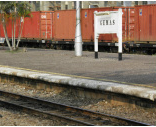
Gemas is the junction of Malaysia's west and east coast lines and starting point for the Jungle Railway. Read about Gemas on my Thrifty Traveller blog.
SEGAMAT
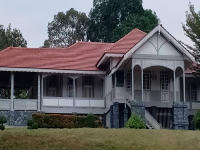
There is a nice public garden here and a few pre-war buildings including the so-called Castle of Segamat.
KLUANG
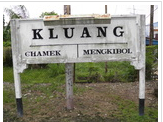
Kluang is famous for its station coffee shop. You can read about my visit to Kluang and the nearby Gunung Lambak here.
KULAI
Kulai these days is a suburb of sprawling Johor Bahru and there is not a huge amount to see here for the traveller.
JB SENTRAL
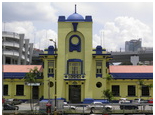
The best way to experience JB's sights is on foot by following my Johor Bahru Heritage Trail.
SINGAPORE

- Home
- Great Malaysian Railway Journeys
Share this page:
AUTHOR BIO

David (the one on the left) is the writer behind Malaysia Traveller, sharing first-hand travel advice from over five decades of living and travelling across Asia and the Middle East. Based in Malaysia since 2009 and now in Kuching, he has published over 790 pages on this website, personally visited every place he covers, and uses only his own photos. Readers can learn more on his About Me page. He also shares updates on Facebook and YouTube. He loves uncovering overlooked places that even some Malaysians have never visited.
Recent Articles


-
Sematan Beach and Sematan Village, Lundu, Sarawak
Sep 03, 26 11:16 PM
 Sematan Beach and Sematan Village is an attractive coastal area within easy reach of Kuching. Here is what you can expect.
 -
Gunung Gading National Park - Rafflesia, Waterfalls and Hiking
Sep 01, 26 01:28 AM
 Enjoy a hike at the pristine Gunung Gading National Park and maybe catch a glimpse of its star attraction, the rare Rafflesia flower in bloom.
 -
Siar Beach - Beautiful Beach Near Lundu, Sarawak
Aug 13, 26 03:04 AM
 The width of Siar Beach varies enormously between high and low tides meaning you have to walk a long way to reach the sea at low tide.


Getting Around
- Free KL City Bus
- KL Hop-On Hop-Off
- BAS.MY Kuching
- BRT Sunway Line
- Malaysia By Coach
- Malaysia By Train
- Pangkor Ferry
- Marina Island Ferry
- Penang to Langkawi Ferry
- Visa Requirements
Hotels
- Pet Friendly Hotels
- Majestic Hotel KL
- Hotels in Melaka
- Hotels in Penang
- Hotels in Putrajaya
- Port Dickson Resorts
Great Malaysian Railway Journeys

CONTACT ME | PRIVACY POLICY | TRAVEL BLOG
Trusted By Over 13 Million Unique Visitors Since 2011. Over 36 Million Page Visits. Statistics up to end August 2026.