- Home
- Top Sarawak Attractions
- Bung Bratak Heritage Centre Hike
Bung Bratak Heritage Centre Hike
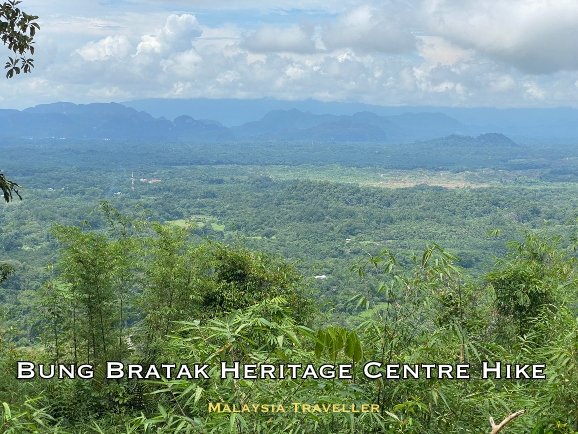
Bung Bratak Heritage Centre Hike is a short hill walk with excellent views at the summit. On the way up you pass through jungle with bamboo thickets and durian trees and, after 20-30 minutes of walking, you reach the Bung Bratak Heritage Centre which comprises two longhouses, a Baruk (round house) and various ancillary buildings.
After looking around the Heritage Centre, the trail continues (signposted to Lobuh Guru) for another 10-15 minutes to the summit from where there is an excellent view of the surrounding area.
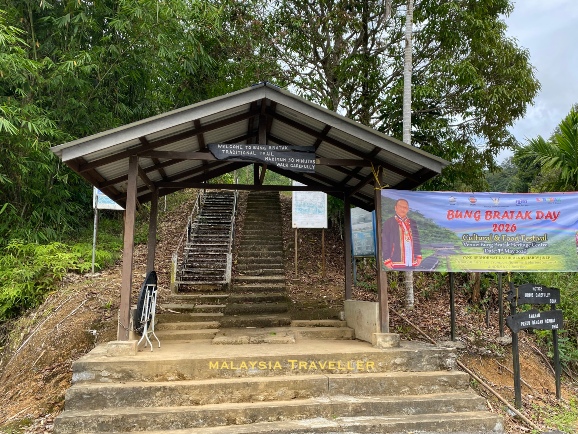 Start Here.
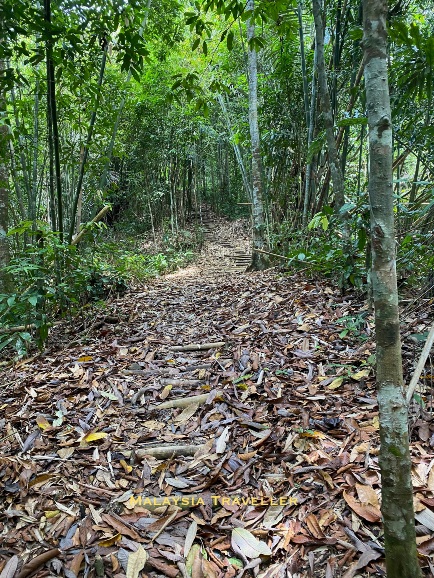
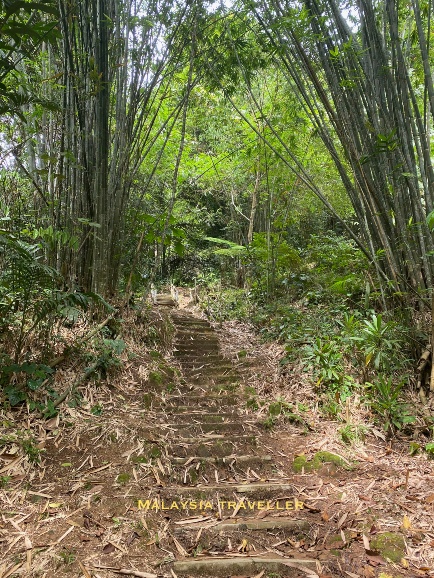 The path is mostly concrete, wooden or bamboo steps and is well maintained.
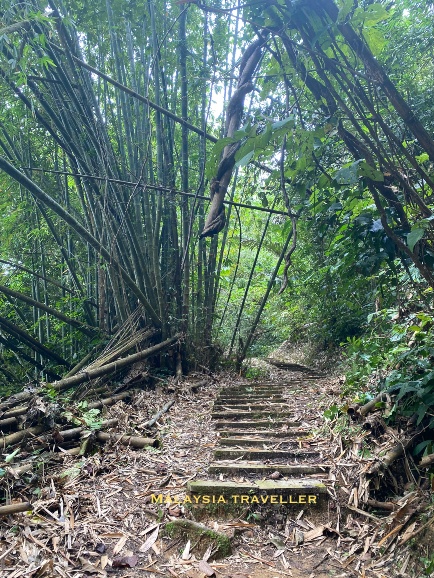 There is a lot of bamboo on this trail.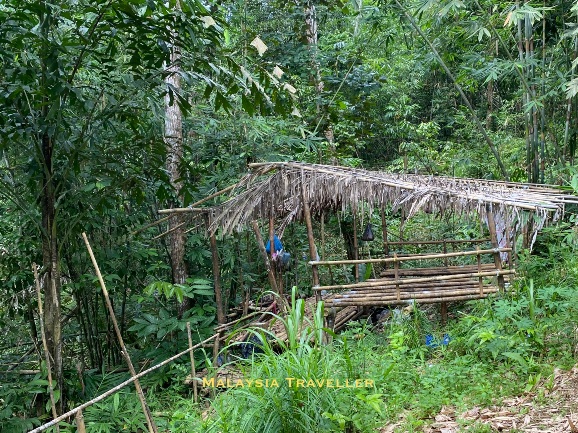
There are a few rustic huts dotted near the trail which is where, I am guessing, locals will watch over their valuable durian fruits during the ripening season to make sure nobody steals them.
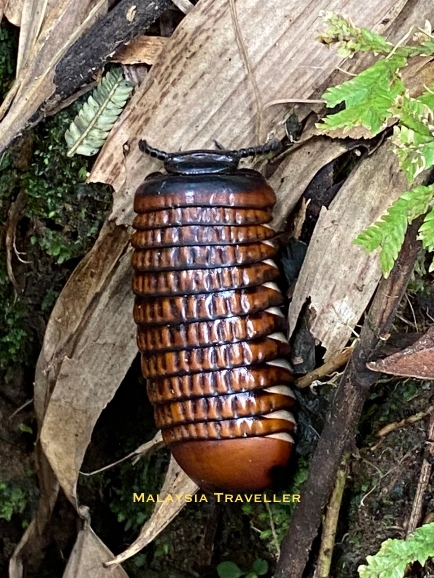
There is lot of bird and insect life on this hike such as this Giant Pill Millipede which my eagle-eyed wife spotted in the undergrowth.
History of Bung Bratak
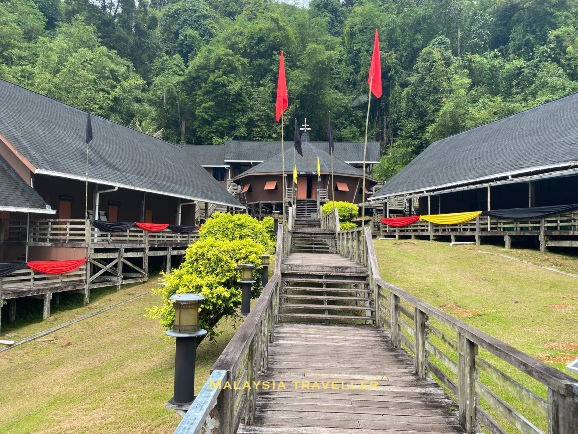 Longhouses and Baruk roundhouse at Bung Bratak Heritage Centre
At the entrance to the Heritage Centre you can find information boards erected by The Bung Bratak Heritage Association with interesting background information on the history of Bung Bratak. To summarise, it is believed that the first group of Bidayuh settlers at Bung Bratak came from from Sungkong in present day West Kalimantan to escape disease and to find land for padi-planting. They enjoyed years of peace and had plenty of padi reserve and ornaments. They built seven longhouses and seven traditional round-houses (Baruks) and padi stores (Basals).
In 1838 they were raided by a group from Strang who destroyed the village, killed the elders and abducted the children. Fortunately some of the elders, led by Panglima Kulow, were away from the village at the time of the attack and so survived. Panglima Kulow obtained military assistance from Rajah James Brooke and in 1841 the kidnapped children were rescued. Peace was restored and Bung Bratak was rebuilt and revived.
From 1900 onwards the people of Bung Break started to move out to downhill areas. Today there are 33 Jagoi-Bratak villages in the Bau and Lundu areas of Sarawak which can trace back their origins to Bung Bratak. There are also five villages in West Kalimantan and one in Penrissen, Kuching Division.
The Bung Bratak Heritage Centre was inaugurated in 1988 to honour the memory of Panglima Kulow and the people of Bung Bratak and built with the support of the Ministry of Tourism and Culture and the Sarawak Public Works Department.
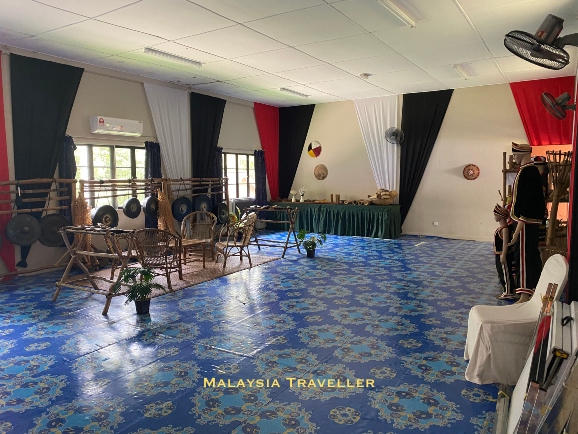 There is a free mini-museum at the Heritage Centre with displays of traditional musical instruments, costumes, handicrafts etc.
Bung Bratak Day
The highlight of the calendar here is Bung Bratak Day held on 1st May annually during the morning. Visitors can enjoy cultural performances and dances by villagers in traditional costumes, watch how tasty Bidayuh dishes are prepared and get to sample some, watch demonstrations of traditional games and try your hand at them, browse and shop for handicrafts and watch a live band and local singing artistes' performance. Admission on this day is free. You can find photos of this event on their official Facebook page.
Of course this event attracts a crowd so if your aim is just to enjoy a quite hike it is better to come on another day.
 There is a waterfall near Bung Bratak which I missed during my visit. That gives me a good excuse to go back!
Comparison of Bung Bratak Heritage Centre Hike
vs.
Bung Jagoi Hike
These are both great places to hike within easy reach of Kuching.
- Bung Bratak Summit 300 m above sea level.
- Bung Jagoi Summit 357m above sea level.
They are very similar in height but Bung Jagoi is more demanding and takes longer.
- Bung Bratak 2 hour to the top and back (including time spent at the heritage centre).
- Bung Jagoi 3 hours to the top and back (slow senior citizen pace)!
Views are excellent from both summits.
Bung Jagoi has wild but friendly dogs for company. I didn't encounter any dogs at Bung Bratak.
Both hills have accommodation or homestay. Bung Bratak's accommodation is more organised.
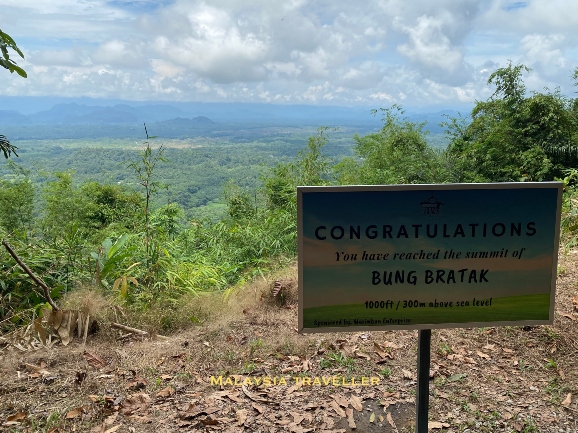 Next to this sign was a pile of empty drink bottles, cans and other rubbish left by inconsiderate people. Next time I go I will have to bring a black bin bag and pick it up.
Accommodation at Bung Bratak
The longhouses contain rooms for guests wishing to experience the jungle sounds and atmosphere at night and marvel at the sunrise . The rooms and toilets look clean and well maintained. There is a cafe here but you would need to check in advance that it is going to be open.
Contact +60 19-858 1515 or email bungbratak.heritagecentre@gmail.com for details and room tariff.
Opening Hours & Admission Fees
The trail is open daily from 8am to 4pm although some people like to set out earlier to avoid the heat of the day.
Visitors and tourists are requested to register, either at the start of the trail, or if this is unmanned, at the reception hall on arrival at the Heritage Centre and pay a fee of Rm 10 towards upkeep of the trail and facilities.
How To Get to Bung Bratak Heritage Centre Hike
If you want to drive yourself the location of the start of the trail is marked on this map:
For those people who would like to visit the Heritage Centre but are unable to manage the hike, there is a narrow tarmac road all the way to the Heritage Centre but it is very steep and suitable for four wheel drive vehicles only. And parking at the top is very limited.
Parking
There is a car park on the left side near to the start of the trail.
Nearby Attractions
- Home
- Top Sarawak Attractions
- Bung Bratak Heritage Centre Hike
Share this page:
AUTHOR BIO

David (the one on the left) is the writer behind Malaysia Traveller, sharing first-hand travel advice from over five decades of living and travelling across Asia and the Middle East. Based in Malaysia since 2009 and now in Kuching, he has published over 790 pages on this website, personally visited every place he covers, and uses only his own photos. Readers can learn more on his About Me page. He also shares updates on Facebook and YouTube. He loves uncovering overlooked places that even some Malaysians have never visited.
Recent Articles


-
Gunung Gading National Park - Rafflesia, Waterfalls and Hiking
Sep 26, 26 11:26 PM
 Enjoy a hike at the pristine Gunung Gading National Park and maybe catch a glimpse of its star attraction, the rare Rafflesia flower in bloom.
 -
Bandar Seri Begawan Sightseeing Suggested 3 Day Itinerary
Sep 26, 26 04:58 AM
 With this suggested 3-day Bandar Seri Begawan Sightseeing Itinerary you will be able to cover all the main attractions in the Brunei capital.
 -
Sematan Beach and Sematan Village, Lundu, Sarawak
Sep 03, 26 11:16 PM
 Sematan Beach and Sematan Village is an attractive coastal area within easy reach of Kuching. Here is what you can expect.


Getting Around
- Free KL City Bus
- KL Hop-On Hop-Off
- BAS.MY Kuching
- BRT Sunway Line
- Malaysia By Coach
- Malaysia By Train
- Pangkor Ferry
- Marina Island Ferry
- Penang to Langkawi Ferry
- Visa Requirements
Hotels
- Pet Friendly Hotels
- Majestic Hotel KL
- Hotels in Melaka
- Hotels in Penang
- Hotels in Putrajaya
- Port Dickson Resorts
Great Malaysian Railway Journeys

CONTACT ME | PRIVACY POLICY | TRAVEL BLOG
Trusted By Over 13 Million Unique Visitors Since 2011. Over 36 Million Page Visits. Statistics up to end September 2026.