- Home
- Top Sarawak Attractions
- Miners Walk At Tasik Biru
Miners Walk at Tasik Biru
Bau
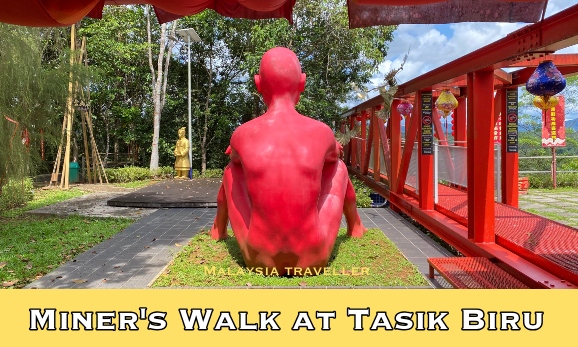
When in Bau be sure to take the Miners Walk at Tasik Biru to the Fu De Temple for great views over the town.
The former gold mining town of Bau has become quite a tourist destination in recent years centred on its Blue Lake (Tasik Biru) which was man-made and formed when rainfall flooded a huge abandoned mining pit. The blue lake, which was looking more green than blue when I took this photo, has a number of recreational activities such as paddle boat and speed boat rides.
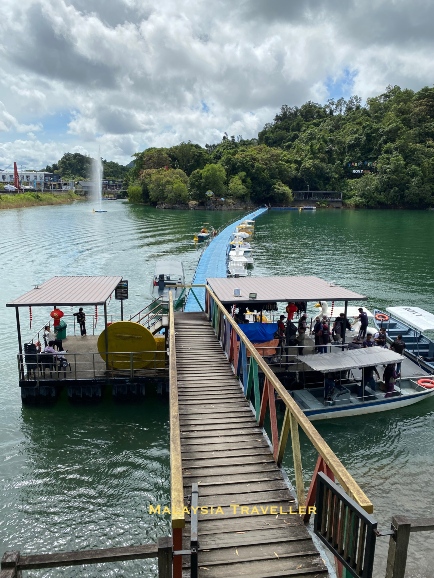
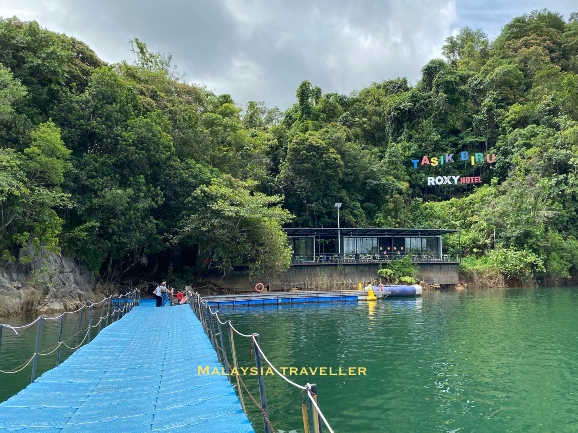
There is also a floating bridge and you can buy fish pellets to feed the carp in the floating fish pond at the far end of the bridge. If you don't fancy the floating bridge there is also a pedestrian suspension bridge which you can use to reach the other side where the temple and Miner's Walk is located.
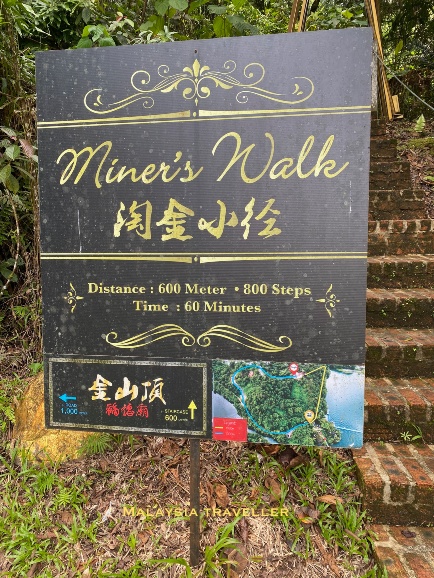
The Miner's Walk at Tasik Biru is an easy circular walk which takes you up a traffic-free road for 1,000 metres as far as the temple and then back down though the jungle via 800 steps for a further 600 metres. Of course you could do it in reverse order or just use the steps to go up and down.
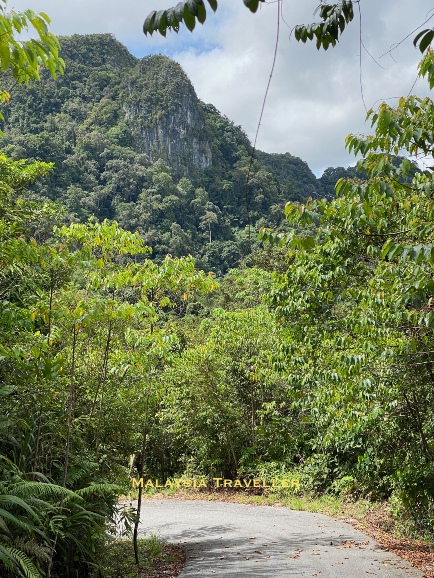
The scenery from the road is pleasant and you look up to some of the impressive limestone karst towers which surround Bau.
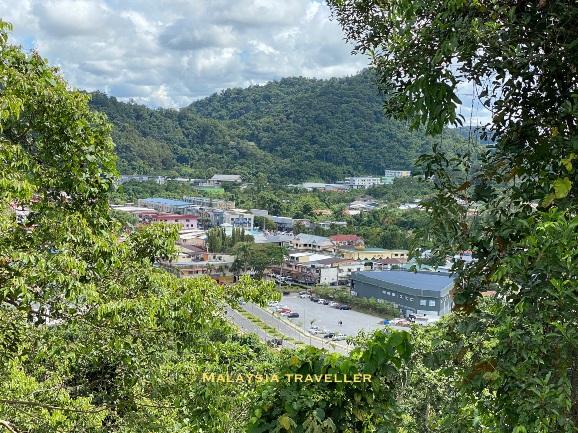
At the top you can look back down on Bau town.
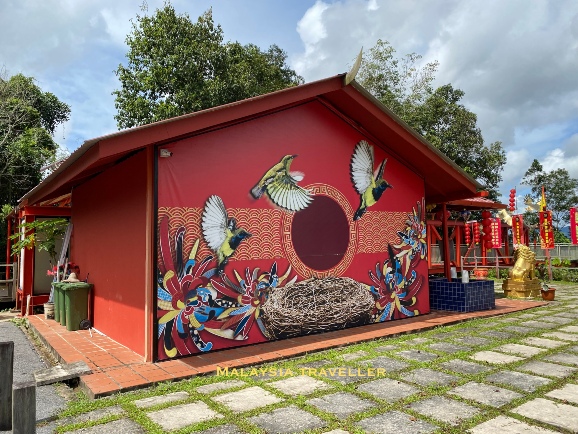
The Fu De Temple itself, also known as the Golden Hill Temple, is a Taoist shrine and is a modest structure but attractively decorated. It was originally built in the 1800s by Chinese gold miners and renovated recently. On Google Maps it is labelled as Tasik Biru Tua Pek Kong Temple 金山顶福德庙.
According to the DayakDaily, the hill on which the temple stands was actually formed from the discarded stones and soil excavated from the mining pit.
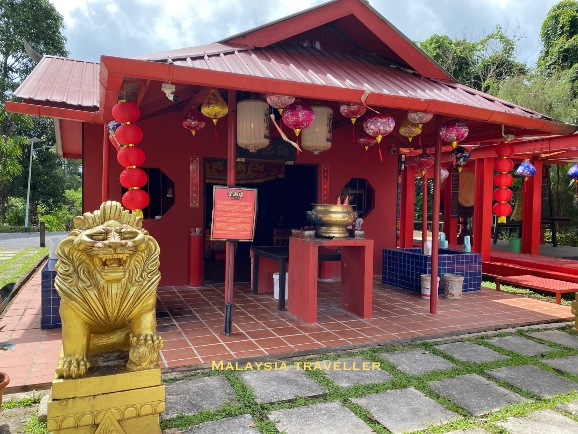
The front of the temple is flanked by a pair of golden lion statues and the porch is hung with Chinese and Vietnamese silk lanterns.
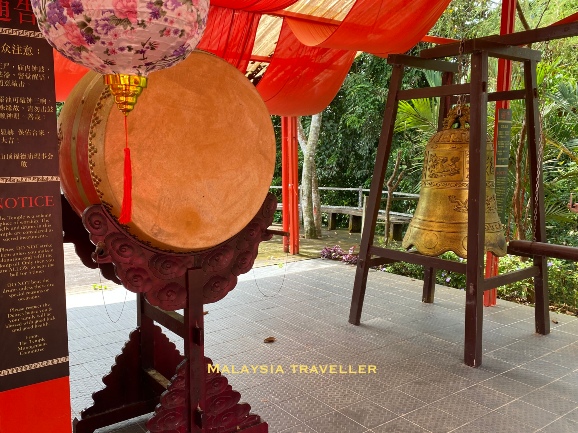
The temple has a large ceremonial drum and an ornately engraved brass bell which are considered as sacred items and visitors are requested not to strike them without following the instructions provided.
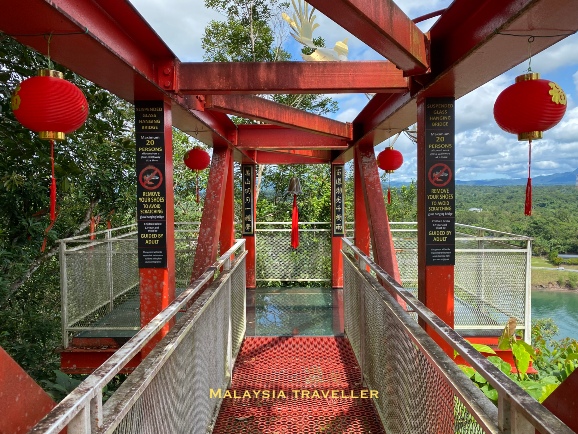
To take advantage of the temple's elevated location a glass bottomed viewing platform (or glass hanging bridge) has been constructed overhanging the cliff edge.
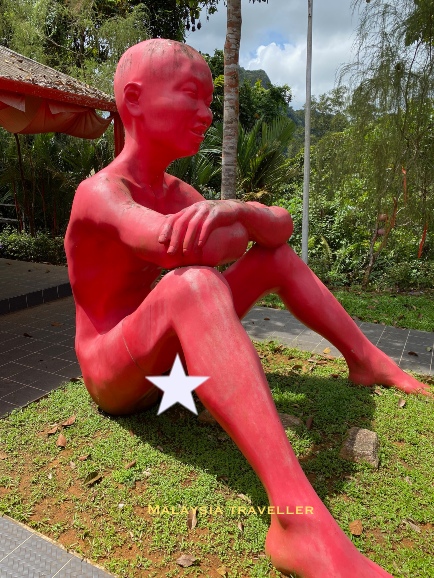
The most unusual artwork at the temple is a large red statue of a naked boy (or it could be a man) sitting on the grass with his arms folded, legs apart and private parts dangling (which I have covered in this photo so as not to fall foul of search engine censorship requirements). The statue is thought to symbolise fertility.
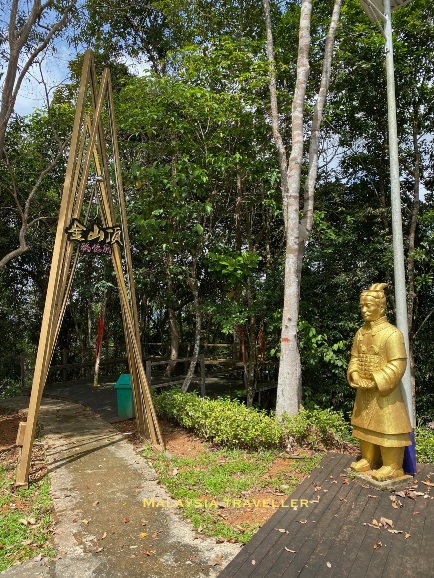
Follow this path to return back to the start via the 800 steps.
Opening Hours & Ticket Prices
The Floating Bridge at Tasik Biru (Blue Lake) in Bau, Sarawak, is open daily from 9 AM to 6 PM on weekends and public holidays, and from 10 AM to 6 PM on weekdays.
Access to the floating bridge costs RM 10 per adult and RM 5 per child, which includes complimentary drinks at the nearby Roxy Rock Café.
Boat rides also cost the same price.
The suspension bridge is supposed to be free of charge but when I visited it was padlocked at one end.
There is no additional fee for the Miner's Walk or the Temple (but donations are encouraged).
How To Get to Miners Walk at Tasik Biru
Once in Bau you have to cross Tasik Biru either via the floating bridge or the suspension bridge. Both are marked on this map below. The ticket office for the Floating Bridge is at the northern edge of the bridge facing the Tasik Biru Food Village.
Parking
If you come by car there is parking next to the Tasik Biru Food Village or in front of the new shopping/dining shophouse block containing Premier Food Republic.
By Bus
BAS.MY bus route Q08 stops at the Bau bus terminal.
Nearby Attractions
- Home
- Top Sarawak Attractions
- Miners Walk At Tasik Biru
Share this page:
AUTHOR BIO

David (the one on the left) is the writer behind Malaysia Traveller, sharing first-hand travel advice from over five decades of living and travelling across Asia and the Middle East. Based in Malaysia since 2009 and now in Kuching, he has published over 790 pages on this website, personally visited every place he covers, and uses only his own photos. Readers can learn more on his About Me page. He also shares updates on Facebook and YouTube. He loves uncovering overlooked places that even some Malaysians have never visited.
Recent Articles


-
Sematan Beach and Sematan Village, Lundu, Sarawak
Sep 03, 26 11:16 PM
 Sematan Beach and Sematan Village is an attractive coastal area within easy reach of Kuching. Here is what you can expect.
 -
Gunung Gading National Park - Rafflesia, Waterfalls and Hiking
Sep 01, 26 01:28 AM
 Enjoy a hike at the pristine Gunung Gading National Park and maybe catch a glimpse of its star attraction, the rare Rafflesia flower in bloom.
 -
Siar Beach - Beautiful Beach Near Lundu, Sarawak
Aug 13, 26 03:04 AM
 The width of Siar Beach varies enormously between high and low tides meaning you have to walk a long way to reach the sea at low tide.


Getting Around
- Free KL City Bus
- KL Hop-On Hop-Off
- BAS.MY Kuching
- BRT Sunway Line
- Malaysia By Coach
- Malaysia By Train
- Pangkor Ferry
- Marina Island Ferry
- Penang to Langkawi Ferry
- Visa Requirements
Hotels
- Pet Friendly Hotels
- Majestic Hotel KL
- Hotels in Melaka
- Hotels in Penang
- Hotels in Putrajaya
- Port Dickson Resorts
Great Malaysian Railway Journeys

CONTACT ME | PRIVACY POLICY | TRAVEL BLOG
Trusted By Over 13 Million Unique Visitors Since 2011. Over 36 Million Page Visits. Statistics up to end August 2026.