- Home
- Top Sarawak Attractions
- Things to See In Kapit
Things to See In Kapit
Sarawak
Welcome to my review of Things to See In Kapit.
I drove to the town of Kapit recently. It is a scenic three hour drive from Sibu with minimal traffic. The road connecting Sibu to Kapit was only completed in early 2022 so it is still fairly new and in good condition and any car can make this trip. The route runs alongside the Rajang River for a good part of the distance and the views are good.
Kapit enjoys an attractive riverside setting with hills around and it is a town with good tourism potential although tourism at the moment is still in its infancy here with limited accommodation and few organised tours or activities available.
Here are a few of the attractions which I noted during my visit:
Fort Sylvia (1880)

This is another Brooke-era wooden fort similar to those at Simanggang, Betong, Kanowit and elsewhere. No photography is allowed inside but the museum exhibits photographs and documents depicting the early history of Kapit. Displays include tributes to Tun Jugah Barieng, who was recognised as paramount chief of the Iban people and served as a Minister of Sarawak Affairs from 1963 to 1974. He was born in Kapit around 1903 and died in 1981.
Signs on the exterior of the fort show the high water marks of past flooding events, the worst of which, in 1934, was a scary 62 feet above the normal river level if I have interpreted the sign correctly.
A plaque gives details of an historic peace-making event at Kapit in 1924 to settle a long-standing feud 'between the Kayans, Kenyahs and Kajangs of the Apoh Kayan and the Sea Dyaks of the Batang Rejang and the Batang Ayer head waters.'
Kapit Waterfront & The Rajang River

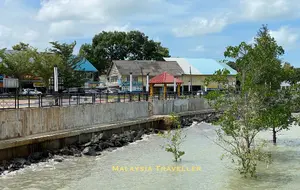
A stretch of the river front has been landscaped with smart new paving, railings, gardens and decorative features. The brown, fast-flowing river itself is probably the top attraction in town and it is a pleasure to sit on the terrace of the newish Hometown Cafe & Bistro and enjoy a drink and meal while watching the sunset and the activities on the river with longboats ferrying school children back home across the river.
Tugu Pahlawan Iban Statue

On the Waterfront stands this impressive statue of a fearsome Iban warrior. Kapit's population is predominantly Iban.
Kapit Town Square

This is an open pedestrianised square in the centre of town with a covered stage for cultural, musical or other events.
Kapit Lily Pond & Park

This pleasant park includes a children's playground, ponds, a lakeside restaurant and so on. Nice, but we didn't see any lilies!
Market Terasang

A two storey covered market with rattan products and local handicrafts in addition to daily food necessities.
Hock Leong Tien Temple

A small temple over a century old.
Kapit Clock Tower

This clock tower a stylised hornbill statue on top stars on a traffic roundabout. The Church of Mary Conception can be seen behind.
Jabal An-Nur Mosque

This is the main mosque in the district.
Hotels

The choice of accommodation in Kapit is somewhat limited. My wife and I stayed at T Lodge. Not bad and we were fortunate to find a parking spot outside the front door. (Parking and traffic congestion seems to be a problem in bustling Kapit as it has not yet fully adapted to the increased traffic reaching the town following the opening of the road from Sibu. Until relatively recently there were only fifteen kilometres of road in the whole of Kapit and visitors had to travel by express boat service or fly).
Location of Things to See In Kapit
Most of the places mentioned in this review can be found on this map:
Nearby Attractions
An hour's drive away is the small town of Song. There is not a lot to see apart from a row of quaint wooden shophouses facing the River Rajang. At the market you can pick up some dabai, known as the queen of fruits with a sweet, creamy, nutty taste. The most delicious dabai in Sarawak are said to be grown in Song.
- Home
- Top Sarawak Attractions
- Things to See In Kapit
Share this page:
AUTHOR BIO

David (the one on the left) is the writer behind Malaysia Traveller, sharing first-hand travel advice from over five decades of living and travelling across Asia and the Middle East. Based in Malaysia since 2009 and now in Kuching, he has published over 790 pages on this website, personally visited every place he covers, and uses only his own photos. Readers can learn more on his About Me page. He also shares updates on Facebook and YouTube. He loves uncovering overlooked places that even some Malaysians have never visited.
Recent Articles


-
Sematan Beach and Sematan Village, Lundu, Sarawak
Sep 03, 26 11:16 PM
 Sematan Beach and Sematan Village is an attractive coastal area within easy reach of Kuching. Here is what you can expect.
 -
Gunung Gading National Park - Rafflesia, Waterfalls and Hiking
Sep 01, 26 01:28 AM
 Enjoy a hike at the pristine Gunung Gading National Park and maybe catch a glimpse of its star attraction, the rare Rafflesia flower in bloom.
 -
Siar Beach - Beautiful Beach Near Lundu, Sarawak
Aug 13, 26 03:04 AM
 The width of Siar Beach varies enormously between high and low tides meaning you have to walk a long way to reach the sea at low tide.


Getting Around
- Free KL City Bus
- KL Hop-On Hop-Off
- BAS.MY Kuching
- BRT Sunway Line
- Malaysia By Coach
- Malaysia By Train
- Pangkor Ferry
- Marina Island Ferry
- Penang to Langkawi Ferry
- Visa Requirements
Hotels
- Pet Friendly Hotels
- Majestic Hotel KL
- Hotels in Melaka
- Hotels in Penang
- Hotels in Putrajaya
- Port Dickson Resorts
Great Malaysian Railway Journeys

CONTACT ME | PRIVACY POLICY | TRAVEL BLOG
Trusted By Over 13 Million Unique Visitors Since 2011. Over 36 Million Page Visits. Statistics up to end August 2026.